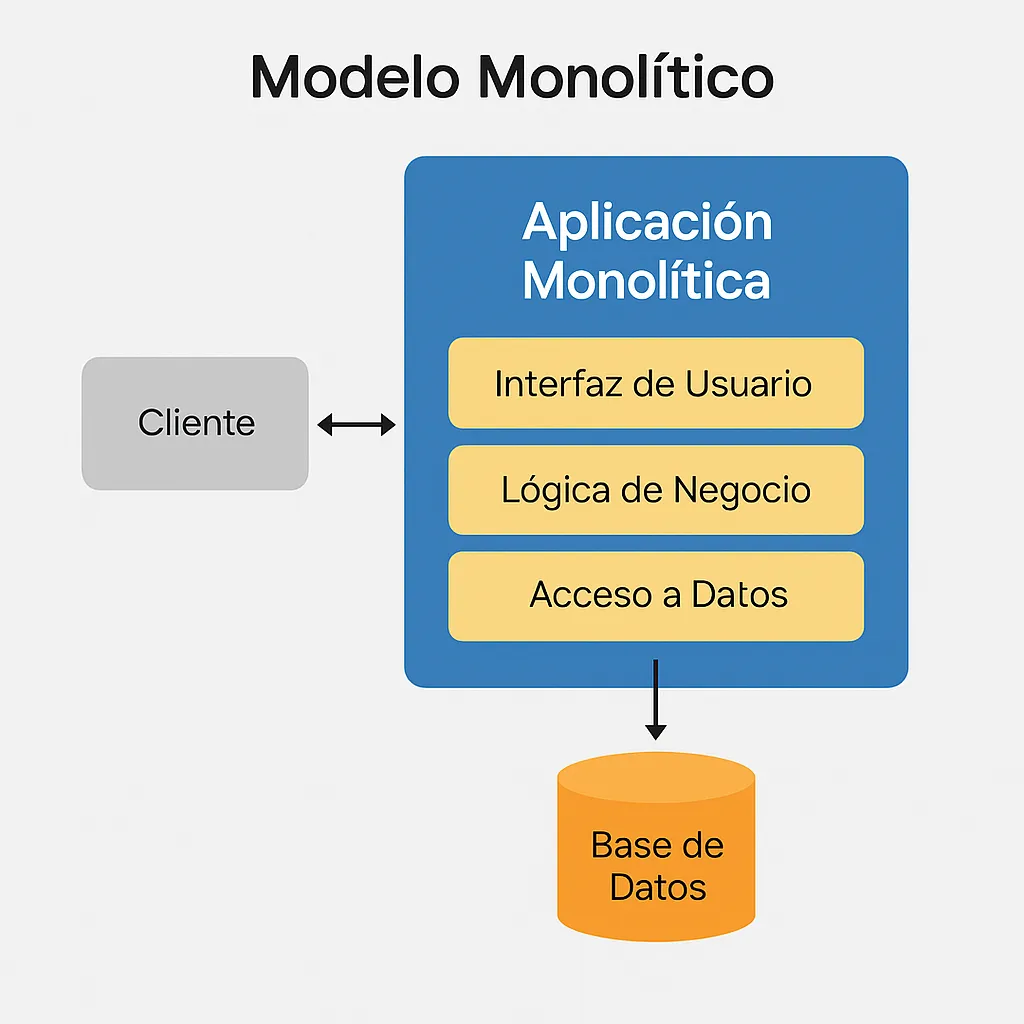
The monolithic model is a way of structuring applications where all components are grouped into a single indivisible unit. From business logic to data access and user interface, everything lives in a single deployment.
# Origin and Historical Context
For years, the most natural way to develop software was in the form of a single program: an application that is compiled, packaged, and deployed as a whole. This approach is simple, direct, and was the standard for decades, especially in enterprise applications built with Java EE, .NET, PHP, and other popular environments.
# How Does a Monolithic App Work?
-
A single codebase.
-
All modules (controllers, services, repositories) are within the same project.
-
A single common database.
-
A single unit of deployment (WAR, JAR, ZIP, executable, etc.).
# Analogy: The Monolithic Restaurant
Imagine a restaurant where a single person cooks, charges, washes dishes, takes orders, and also manages the business. All in one body. It works well if there are few customers, but if the business grows, that person collapses.
# Advantages
-
verified
Simplicity
Initial simplicity in development and deployment.
-
verified
Testability
Easy to test comprehensively.
-
verified
Ideal for MVPs
Ideal for early-stage products.
# Disadvantages
-
warning
Scalability
Difficulty in scaling by module (you have to scale it all together).
-
warning
Coupling
Strong coupling between components.
-
warning
Risk in Deployments
Any change implies repackaging everything.
# Technical Example (Spring Boot)
Typical Monolith in Java
@RestController
public class ProductController {

  @Autowired
  private ProductService productService;

  @GetMapping("/products")
  public List list() {
    return productService.getAll();
  }
}
The controller, service, and data access live in the same project and are deployed together.
# When to Choose a Monolith?
Although it's fashionable to talk about microservices today, the truth is that many startups and small teams should start with monoliths. They are fast to develop, easy to test, and allow focusing on the business value.
# Conclusion
The monolithic model is not dead. On the contrary, it is the natural starting point for many systems. The important thing is to know when to migrate to another architecture, such as microservices, without falling into the hype.