This chapter introduces the Unified Modeling Language (UML), an essential tool for visualizing, specifying, building, and documenting the artifacts of a software system.
We will see its importance, how it works, and how it can be used to model classes and relationships in your projects.
# What is UML?
UML (Unified Modeling Language) is a standard modeling language used to represent and communicate the structure and design of software systems.
Developed in the 1990s, UML has evolved to become the standard for software modeling, helping developers visualize and build complex systems in a coherent and understandable way.
# Importance of UML in Software Development
-
Clear Communication: UML provides a common vocabulary for developers, analysts, and stakeholders to understand the system.
-
Visualization: It allows visualizing the system's structure and design before coding, which helps in planning and analysis.
-
Documentation: It offers a standardized way to document important aspects of the system, which is crucial for maintenance and scalability.
# Main Components of UML
UML is composed of several types of diagrams, each designed to visualize different aspects of the system.
Some of the most relevant for modeling classes and relationships include:
-
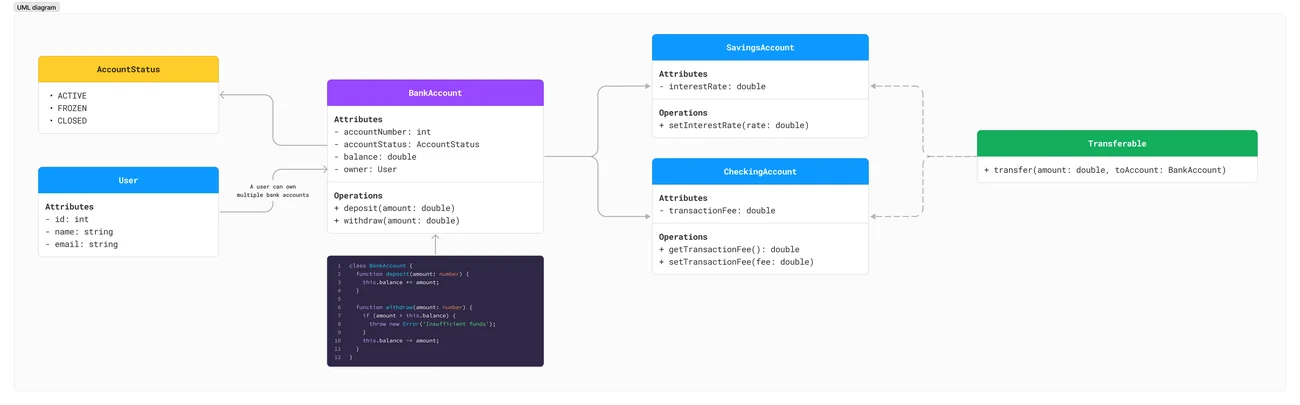
Class Diagrams: They show the system's classes, their attributes, methods, and the relationships between them, such as inheritance and association.
-
Object Diagrams: They are instances of class diagrams and show how class instances relate to each other in a specific context.
-
Use Case Diagrams: They represent system functionality from the user's perspective, illustrating how different actors (users or systems) will interact with your application.
-
Sequence Diagrams: Sequence diagrams detail how objects and messages flow through various processes.
# Modeling Classes and Relationships with UML
UML is especially powerful in representing class structure and their relationships. Some key concepts include:
-
Classes: Represented by rectangles divided into three sections: class name, attributes, and methods.
-
Relationships: Include association (simple lines), inheritance (lines with a hollow triangle at the end), and aggregation or composition (lines with a diamond).
-
Multiplicity: Indicates how many instances of one class can be associated with an instance of another class.
# Tools for Creating UML Diagrams
Several tools are available for creating UML diagrams, from simple online applications to more robust software. Some popular examples include Figma, Lucidchart, Draw.io, and StarUML.
# Example: Modeling a Library System
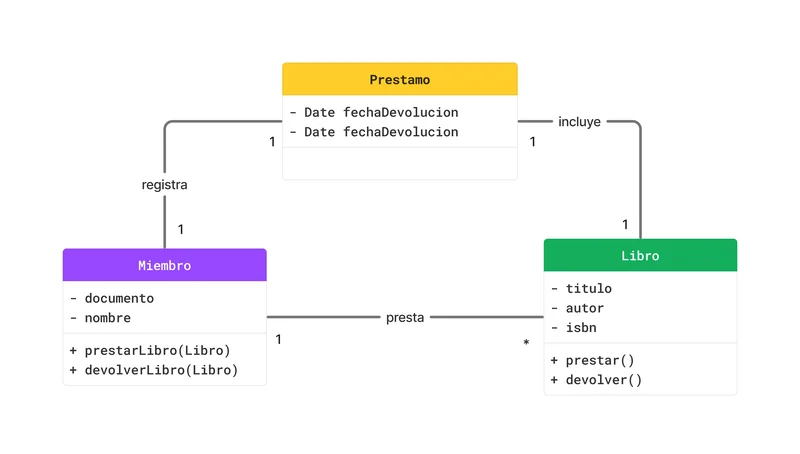
Imagine you are designing a library system. You could use UML to model classes like
Book, Member, and Loan, as well as their
relationships:
-
Book: Would have attributes like title, author, and ISBN, and methods for actions like borrowing and returning.
-
Member: Would include details like name, ID, and a list of borrowed books.
-
Loan: Could have information about borrow and return dates and be associated with
BookandMember.
This is a possible class diagram to represent these entities and their interactions, clarifying how they interrelate and work together to form the system.
# Tips for Mastering UML
-
Practice Regularly: Like any language, fluency in UML comes with practice. Use UML in your projects, even the small ones.
-
Study Examples: Examine UML diagrams of existing systems. Many open-source projects include them in their documentation.
-
Collaborate and Get Feedback: Share your diagrams with colleagues or mentors. A fresh perspective can reveal aspects you might have overlooked.
# Conclusions
UML is much more than a set of symbols and rules; it is a language that facilitates the expression of ideas, problem-solving, and effective communication in the software development world.
By using UML, you not only improve your ability to conceptualize complex systems but also equip yourself with an invaluable tool for collaborating and sharing your visions with others.
In this series of chapters, we will focus mainly on the class diagram to observe the structure of the mentioned cases.